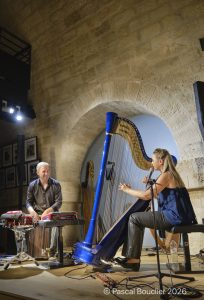
The day I realized that the score was no longer enough
One day, they said, "Make a solo on the next eight measures. Since you're a classical musician, you need to know how to do it!"
And there, silence. Not a musical silence, a real inner void. I found myself facing a dilemma: either to recognize that I had no idea what was being asked of me, or to try something... without understanding the rules of the game.
Although I was very well trained in classical: reading a score without difficulty, playing with other instruments, following the conductor on the millimetre, raising songs in the ear... But nobody ever taught me how to improvise.
I felt lost. Yet I knew it existed: I had heard about jazz, improvisation, but never in my harp classes had I told me how to do it.
What I didn't learn in classical... but that I then discovered
I took time to understand that yes, there are rules in improvisation, as in any musical language. I started to listen to the great musicians, raise their solos, observe how they build, transform a theme.
But when it was necessary to improvise in real life, in front of other musicians... everything I had learned, I still didn't know how to use it.
So I built my own method: a mixture of my classic luggage, my ear, my research and a lot of test-errors. Today, whether it's in my tutorial videos or live on the group Pop and Jazz Harp, every idea comes from a lived experience, from a lesson learned on the way.
Why the classical transition – jazz and impro seems so difficult
This passage is often misunderstood – or ignored.
This is why it is complicated (but not impossible):
– Few teachers are able to guide this transition, because they are two different musical cultures, yet... they can complement each other wonderfully.
– It is thought that the classical system only learns reproduction, not creation. But that's not true! We are already creative performers, thanks to all the hours spent decorating works by Bach or Ravel.
What's missing? A bridge, a translator. And that's where I intervene today, after having lived both sides.
When you come out of the classic to open up to jazz or improvisation, you must not deny anything. On the contrary: you can transform your knowledge, value it in another language.
And even if jazz or MAA use "codes", we already know a lot without knowing it.
Just see them differently.
Playing without a score is possible... and liberating!
Learning one piece by heart is not improvising. Improvising is playing here and now, without support, listening to play.
And that freedom can be scary. Especially when, like me, we've been used to playing exactly what's written.
But imagine: with each new interpretation of a theme, you can transform it, color it differently.
You can dare play something unique, personal, and express your emotions directly through your instrument.
Yeah, that seems impossible at first. But with the harp, it's even more magical, because we have this huge palette, these resonances, this expressive potential... that just wake up.
The 3 truths I would have liked to hear before I improvised
It's not a lack of talent. It's a change of culture.
1. Improvising is not reserved for an elite. It's just another way to approach music. During my first jazz workshop, despite all my years of study, I felt illegitimate. But I realized I was just... learning a new language.
2. Your ear becomes your main instrument.
In the classic, we follow the score. In jazz and MAA (Actual Amplified Music), it is your ear that guides your fingers. This shift is difficult but liberating. We must learn to listen actively, to identify forms, rhythms, harmonies.
3. Your groove is unique – do not copy it, cultivate it.
The groove is not just "play funky". It's feeling time, embodying a rhythm, living a pulse. This link between gesture, listening and expression is often absent from classical training. Yet, it is a fundamental element in current music and jazz.
We can and must inspire great musicians. Guitarists like Joe Pass for their phrasing, pianists like Bill Evans for their harmonic finesse, but also pioneer jazz harpists, like Dorothy Ashby . Alice Coltrane. They remind us that the harp has its place in living and creative music.
My approach: a bridge between the worlds
In my teaching, I do not deny my classical background. I lean on it to propose a hybrid pedagogy, open, accessible.
The fact that I play the piano, that I sing, enriches my relationship to music, composition, improvisation. And all this, I transmit it in my internships, my accompaniments, my videos.
To make progress, one must continue to listen, analyze and inspire. As we did in classic before playing a work with orchestra.
And today, thanks to artists like Park StickneyWe know that the harp can sound like a guitar or a piano... and much more.
Anything is possible.
3 concrete tools to start improvising with harp
1. Sing what you play. Even slowly. This develops the ear and immediate connection to your instrument.
2. Create simple loops. A bass, a chord, a pulse. And improvise on it with few notes.
3. Copy a musician you love. Take a few measurements and adapt them to your harp.
To go further together
For all these reasons I created the Facebook group Pop and Jazz Harp, a caring space to ask questions, exchange and support each other.
It also organizes online or face-to-face courses to work in depth on improvisation, rhythm, groove and harp music expression.
If you want to receive my resources, internship information and musical inspirations, subscribe to my newsletter (see the form below).
And above all, I ask you this question: What did you find out when you dared to leave the written frame?
Share your experience in comment or Write to meI'll read you with pleasure.